Disclosure: As an Amazon Associate, we earn from qualifying purchases.
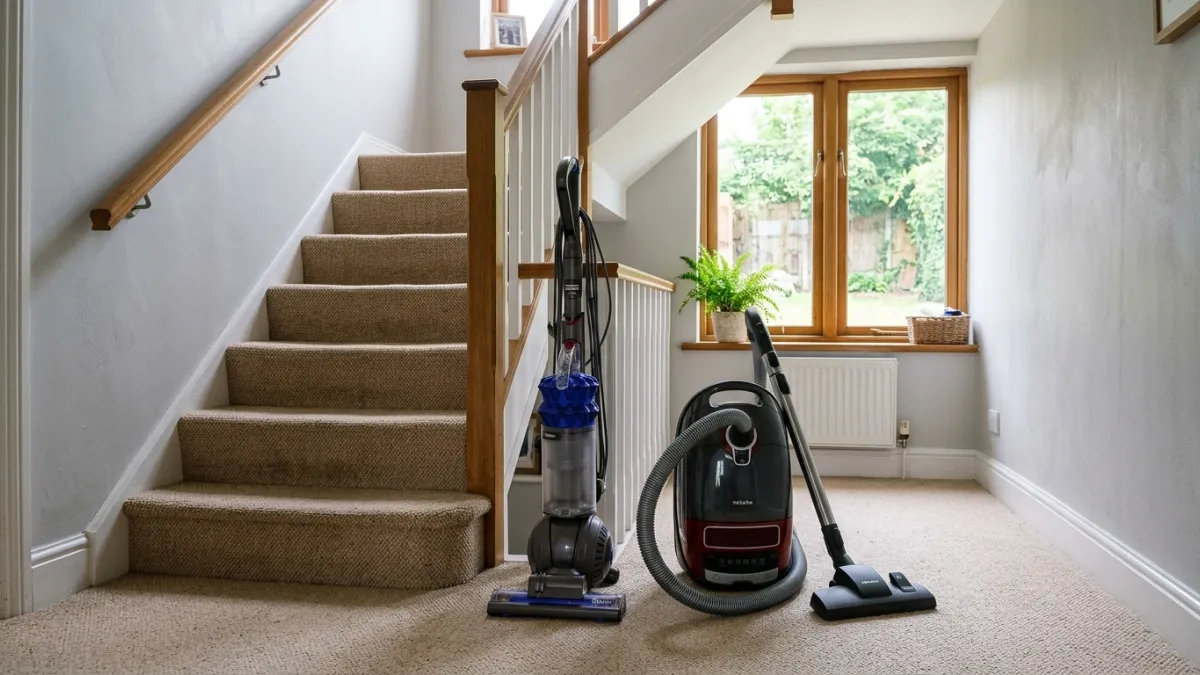
Cleaning tight spaces, vertical carpet risers, and soft furniture is one of the most frustrating parts of routine home maintenance. While standard flat flooring allows almost any floorhead to glide smoothly, tackling stairs and upholstery forces you to battle gravity, maneuverability, and awkward weight distribution. Choosing the right vacuum architecture for these specific jobs saves your back, speeds up your workflow, and prevents premature fabric wear.Quick answer: Canister vacuums are superior for cleaning stairs and upholstery because the heavy motor stays parked on the floor while you carry only a light hose and attachment (often under 3 lbs). Upright vacuums force you to lift an 11-18 lb machine up steps or balance it precariously while relying on short, stretch-restricted hoses that can easily pull the vacuum over.
Understanding the Physical Demands of Stairs and Soft Furnishings
When cleaning flat hardwood or wall-to-wall carpeting, the main weight of a vacuum cleaner rests squarely on its wheels. You simply push and pull against mild rolling resistance. However, cleaning a flight of 12 to 15 stairs or deep-cleaning a section couch changes the mechanical equation entirely. On stairs, every step requires lifting, balancing, or stretching your equipment. If your machine is poorly suited for vertical elevation, you risk dropping the unit, pulling muscles, or missing half the embedded grit.
Upholstery presents a different challenge altogether. Unlike firm carpet backing stretched across subfloors, sofa cushions and chair fabrics are flexible and prone to getting sucked into high-airflow nozzles. Cleaning furniture effectively requires high static lift paired with specialized motorized brush tools or velvet lint strips, rather than heavy roller heads designed for open floors. The physical design of your vacuum dictates whether reaching behind cushions and over stair nosing feels effortless or like an exhausting wrestling match.
From a safety standpoint, stair cleaning causes thousands of household falls each year. lugging a heavy appliance up a narrow staircase while blind to your foot placement is inherently risky. A light wand and ergonomic handpiece reduce fatigue and keep your center of gravity stable, which is why commercial cleaners rarely use standard uprights on multi-level properties without specialized hose extensions.
Canister Vacuums: Why Architecture Favor Vertical & High-Reach Cleaning
Canister vacuums separate the motor, dustbag/bin, and heavy components into a mobile base unit that sits on small swivel castors. A flexible suction hose extends from the base, connecting to a lightweight metal or plastic wand. For stair treads and upholstered furniture, this split architecture offers fundamental physical advantages that upright units struggle to replicate.
When tackling a flight of stairs with a canister system, you leave the main body resting safely at the landing or on a lower tread. You carry only the hose assembly, which typically weighs between 2 and 3.5 pounds. This light hand-weight allows you to maneuver small turbine brushes (such as a Miele STB 205-3 or a Sebo handheld turbo brush) rapidly across stair treads, risers, and tight corners without straining your wrists or back. Modern canisters like the Miele Complete C3 or Sebo Airbelt D4 offer long operating radii (33 to 40 feet), allowing you to clean an entire flight of stairs without changing electrical outlets.
For upholstery, canister models excel because their airflow is isolated through smooth wands, producing strong sealed suction without requiring broad intake heads. Most premium canisters offer variable suction controls—either digital buttons or rotary dials—allowing you to drop the motor power from a maximum of 1,200 Watts down to low settings (around 300-500 Watts). This prevents fine fabrics, silk curtains, or velvet cushions from sticking violently to the attachment while still pulling out pet dander and deep-seated dust.
Miele Complete C3 Calima Bagged Canister Vacuum Cleaner with Turbobrush floorhead, Suitable for Low-Medium Pile Carpet and Hard Floors, in Curry Yellow

Upright Vacuums: Strengths, Limitations, and Safety Hazards on Stairs
Upright vacuums integrate the motor, handle, bag/bin, and primary motorized brush roll into a single rigid body. While uprights are widely celebrated for fast, high-performance cleaning across wide carpeted rooms due to direct downward weight and wide brush rolls, applying that design to stairs and furniture reveals several structural drawbacks.
The average mid-to-full-sized upright vacuum weighs between 13 and 19 pounds (for instance, a traditional Shark Apex or Hoover WindTunnel). Carrying this mass step-by-step demands significant upper-body strength. If you choose to leave the upright at the base of the stairs and rely on its stretch hose, you quickly encounter hose tension. Stretch hoses on uprights act like tight springs; pulling the hose up more than 4 to 6 steps creates strong backward tension that frequently tips the main unit over, risking damage to hardwood flooring or causing the heavy vacuum to tumble down the steps toward you.
Cleaner's tip: If you must use an upright vacuum on carpeted stairs, never leave the machine running on a flat step while using the stretch hose above it. The vibrating motorized floorhead can vibrate itself right off the stair edge. Always lock the brush roll off or place the vacuum on a wide, stable landing, securing the base with one foot while working within the hose's relaxed reach distance.
uUprights do offer convenience for quick surface sweeps on ground-floor furniture if they feature lift-away pods (such as Shark's Powered Lift-Away series). In lift-away mode, the canister pod detaches from the heavy floor base, turning the upright into a semi-portable unit. While this partially bridges the gap between uprights and canisters, the pod remains bulkier and heavier in hand than a dedicated canister wand, and the hose length remains comparatively short.
Feature-by-Feature Comparison: Upright vs Canister
To evaluate which style fits your home's layout, it helps to examine specific performance metrics directly affecting stairs, sofa maintenance, and elevated surfaces.
| Performance Factor | Canister Vacuums | Upright Vacuums |
|---|---|---|
| In-Hand Weight on Stairs | Lightweight (2.0 – 3.5 lbs) | Heavy (11.0 – 18.5 lbs) or Pod Weight (7 – 10 lbs) |
| Suction Performance (Air Watts) | High sustained airflow (140 – 220 AW) | Strong sealed lift (100 – 180 AW) |
| Hose Reach & Tension | 7 to 10 ft non-stretch hose; zero pull-back | 6 to 12 ft stretch hose; moderate to high pull-back |
| Filtration Standards | Sealed HEPA (retains 99.97% @ 0.3 microns) | Varies (Sealed HEPA on mid/high-tier models) |
| Suction Control for Fabrics | Variable speed controls / suction bleeds | Manual air-bleed valve (on select models) |
| Average Price Range (2026) | $250 – $1,200+ | $120 – $450 |
Motorized vs Air-Driven Attachments for Fabric and Treads
Shark Navigator Lift-Away Upright Vacuum Cleaner, HEPA, White, NV356E

Cleaning ground-in dog hair from carpeted stair treads or micro-suede couches requires agitation. Simple suction nozzles leave embedded fur behind. Both vacuum types utilize two types of mini brush tools: air-driven mini turbo brushes and direct-drive motorized hand tools.
Air-driven turbine tools use the vacuum's incoming airflow to spin an internal turbine, which drives a small brush roll. They are lightweight and work exceptionally well on canister vacuums with high Air Watt (AW) ratings (180+ AW). However, if you press down too hard on dense carpet, the turbine can stall. Direct-drive mini motorized tools (commonly found on premium uprights and cordless stick hybrids like Dyson or Bissell CleanView units) maintain constant brush rotation regardless of downward pressure, making them highly effective for severe pet hair buildup, though they add extra weight to the hand piece.
Filtration and Duster Performance on Soft Furnishings
When vacuuming furniture, dander, dust mite droppings, and fine skin scales are disturbed and pulled into the air stream. If your vacuum lacks a fully sealed system, those microscopic particles leak straight out through the housing seams back into your breathing zone. For allergy sufferers, canister units from certified brands (like Miele, Sebo, or Numatic) feature rubber-gasket sealed frames paired with HEPA H13 filters (capturing 99.97% of particles down to 0.3 microns), ensuring that disturbed upholstery allergens remain permanently trapped inside the dust bag.
Frequently Asked Questions
Can I clean stairs safely with a heavy upright vacuum?
Yes, but it requires extra care. If your upright has a detachable canister pod (lift-away feature), disconnect the pod to carry it in one hand while using the detail tool in the other. If it does not detach, keep the upright parked firmly at the bottom of the flight and use an extension hose. Never leave a running upright balanced on an upper stair step, as motor vibrations can cause it to fall.
Which attachment is best for removing pet hair from sofa fabric?
Pet Turbo Brush Attachment | Compatible with Bissell Vacuums – Air-Driven Pet Hair Eraser Tool – Fits CleanView, PowerForce, Pet Hair Eraser & More – Replaces 1634607 & 1614936, 1607765

A mini motorized brush attachment or a high-RPM air-driven turbo tool is ideal. For delicate woven upholstery that might snag under a spinning brush, use a dedicated lint-strip upholstery nozzle combined with high suction power.
Are canister vacuums harder to store than upright vacuums?
Canister vacuums require a slightly wider footprint in a closet because the flexible hose and wand must be parked alongside or wrapped around the body. However, many modern canisters feature dual parking slots on the side and bottom to store upright in narrow closets.
What suction power rating should I look for when buying a vacuum for stairs?
Look for a vacuum with at least 140 to 180 Air Watts (AW) or a sealed suction lift measurement of 80 to 100 inches of water lift. This ensures the unit maintains strong pulling power through accessory hoses and mini attachments.
Final Recommendation
If your home features multiple flights of carpeted stairs, delicate furniture fabrics, and high dusting needs, investing in a high-quality sealed canister vacuum (such as a Miele Complete series or Sebo Airbelt) is the clear winner for ergonomics, safety, and long-term convenience. However, if your budget is strictly under $250 and your living space consists primarily of wide carpeted rooms with only a few flat steps, a versatile upright vacuum with a detachable lift-away pod and a motorized hand tool provides excellent carpet agitation and good value for money.
Sources
- Miele Operating Manuals & Technical Floorcare Specifications
- US Environmental Protection Agency (EPA) - Guide to Indoor Air Quality and HEPA Standards
- Carpet and Rug Institute (CRI) - Vacuum Cleaner Testing & Seal of Approval Program
Looking for the Right Tools?
Check out our verified Top Cleaning Tools & Supplies on Amazon.
As an Amazon Associate, we earn from qualifying purchases.