Disclosure: As an Amazon Associate, we earn from qualifying purchases.
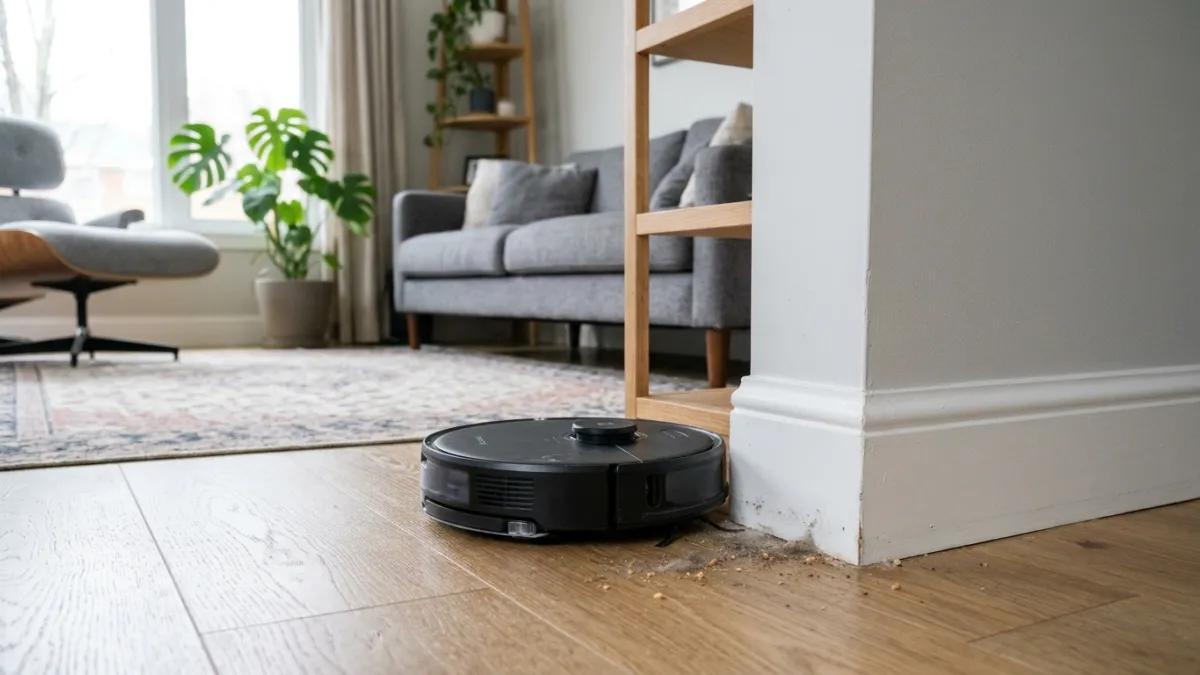
If you have ever watched your robotic vacuum navigate around a room, you have probably noticed a frustrating pattern: while it glides effortlessly across open hardwood or carpet, it leaves a fine line of dust along baseboards and completely skips tight 90-degree corners. You spend hundreds of dollars on automated floor care, only to find yourself pulling out a hand broom or an upright vacuum attachment to clean up the perimeter. After testing dozens of robotic cleaners over the past decade—from basic bump-and-go units to high-end LiDAR navigation systems—I can tell you that this problem rarely means your device is broken. Instead, it is usually a combination of physical hardware constraints, optical sensor limitations, and improper maintenance routines.
Quick answer: Round robot vacuums naturally fail to reach sharp corners due to their circular physical footprint and short side brushes. Most navigation software is deliberately programmed to keep the bumper 1 to 2 centimeters away from walls and baseboards to prevent scuff marks and sensor recalibration errors.
Understanding the Physical and Optical Limitations of Robot Vacuums
The primary reason your robot vacuum struggles with perimeter cleaning comes down to basic geometry. The vast majority of consumer models sold by brands like iRobot Roomba, Roborock, Shark, and Eufy feature a round body shape. A circular chassis with a diameter ranging between 13 and 14 inches simply cannot fit into a 90-degree square corner. The main roller brush is housed centrally underneath the machine, usually sitting 2 to 3 inches away from the outer edge of the plastic shell. Without assistance, the central vacuum intake never physically passes over the dust resting directly against the wall.
To bridge this physical gap, manufacturers install spinning side brushes equipped with flexible nylon bristles. However, these side brushes have practical limitations. As they rotate at speeds between 130 and 200 RPM, they are designed to flick debris inward toward the main suction path. When a side brush gets worn down, bent, or tangled with hair, its effective reach drops significantly. Furthermore, light debris like pet hair or dry cereal is often flung away from the corner rather than swept into the vacuum inlet if the brush spins too fast or the suction power—typically measured between 2,000 Pa and 10,000 Pa on modern 2026 units—is set too low to catch flying particles instantly.
Optical and safety sensors also actively prevent the robot from making direct contact with your walls. Modern robotic cleaners rely on infrared wall sensors, optical cliff sensors, LiDAR turrets, or front-facing 3D structured light cameras to map their environment. To prevent your robot from scuffing white baseboards, damaging delicate furniture legs, or scratching paint, software algorithms dictate a safe cushion distance. The vacuum's brain instructs the drive wheels to slow down and maintain a buffer zone of a few millimeters away from vertical obstacles, which unfortunately leaves wall-adjacent dust untouched.
Design Comparison: Round vs. D-Shape and Extending Mechanical Arms
Not all robot vacuums tackle edges in the same way. The market has evolved from simple round discs into engineered units designed specifically to target hard-to-reach perimeter dust. Understanding how different chassis designs and emerging robotic technologies handle corners can help you evaluate whether your current machine is performing to its full physical potential or if it is time to upgrade.
Compatible with Roborock FlexiArm External Side Brush Motor Module for Q Revo Master Edege S8 Max S8 MaxV Ultra Robot Spare Parts Accessories

| Design Feature | Corner Coverage Capability | Primary Hardware Mechanism | Common Limitations |
|---|---|---|---|
| Standard Round Chassis | 60% – 70% Coverage | Fixed 3-arm or 5-arm spinning side brush | Cannot physically fit inside 90° square corners; relies entirely on brush length. |
| D-Shaped Chassis | 85% – 92% Coverage | Flat front housing wide roller brush right at the edge | Harder to navigate tight chair legs; prone to getting wedged in narrow spaces. |
| Extending Side Arms (2025–2026 Models) | 95% – 98% Coverage | Robotic arm extends side brush/mop out to touch corners | Additional moving mechanical parts; slightly higher risk of long-term wear. |
D-shaped designs, historically popularized by Neato and incorporated into select specialized models, position a flat front edge directly against the wall. This allows the main brush roll to extend almost the entire width of the machine's front, bringing pure suction right up to the baseboards. However, round vacuums remain the industry standard because they rotate 360 degrees effortlessly without getting trapped between dining room chair legs or tight furniture clusters.
To overcome the round shape limitation, flagship 2026 models from brands like Roborock (FlexiArm technology) and Dreame employ motorized extending arms. When the vacuum's optical sensors detect a right-angle corner or baseboard wall, a small mechanical actuator physically pushes the spinning side brush or mop pad outward past the vacuum's main chassis. This hybrid approach delivers the agile navigation of a round robot while reaching deep into square corners.
Common Causes of Poor Edge and Corner Cleaning
If your robot vacuum used to clean edges effectively but has recently started leaving behind noticeable debris, hardware degradation or environmental changes are usually to blame. Over time, normal household use introduces several factors that degrade edge-sweeping performance.
Cleaner's tip: Never pull or stretch bent side brush bristles by hand. Instead, unscrew the side brush module and submerge the nylon bristles in a cup of hot water (around 160°F to 180°F) for 60 seconds. The thermal memory of the nylon will cause the bristles to straighten right back out to their original factory angle, restoring full edge reach without spending money on replacements.
- Worn or Deformed Side Brushes: As the robot travels along hard floors and carpets, the nylon bristles drag continuously against coarse surfaces. Over 3 to 6 months, bristles curl inward, split, or become matted with long hair. Shortened bristles no longer span the gap between the vacuum hull and the corner wall.
- Dirty Edge-Following Sensors: Most vacuums feature a small clear lens located on the right side of the front bumper. This infrared wall sensor measures distance to the baseboard. When covered in fine drywall dust, pet dander, or smudges, the sensor incorrectly reports that the wall is closer than it actually is, forcing the robot to steer away prematurely.
- Aggressive Collision Avoidance Settings: In high-end mobile apps (such as those for Roborock, Dreame, or Ecovacs), advanced obstacle avoidance settings let users toggle sensitivity. High sensitivity modes treat baseboard trim, floor molding, and curtains as solid obstacles, prompting the vacuum to maintain a wide 2-to-3-inch avoidance perimeter.
- Low Suction Power Settings: Running your device on "Quiet" or "Eco" mode reduces fan power, often dropping suction below 1,500 Pa. While adequate for loose surface dust on open tile, low static pressure cannot lift fine grit trapped in the gap between carpet tack strips and baseboards.
Step-by-Step Guide to Fix Edge and Corner Vacuuming Performance
10Pcs Robot Vacuum Cleaner Side Brush Improved Efficiency Universal Accessories Efficiency Improvement Universal Accessory for Machine, Cleaner Brushes

Restoring your vacuum's edge cleaning capability does not necessarily require buying a new machine. Following a systematic maintenance and recalibration process will significantly improve how much dirt your robot picks up along walls.
- Inspect and Maintain the Side Brush: Remove the retaining screw or press the release tab to detach the side brush assembly. Clear tangled hair wrapped around the drive shaft underneath. If the bristles are frayed or missing arms, replace the module. Standard replacement packs usually cost between $10 and $20 for a set of four.
- Clean the Infrared and Wall Sensors: Take a soft, dry microfiber cloth (ideally 300 to 350 GSM) and gently wipe down the lateral wall sensors, front cliff sensors on the underbelly, and the top laser navigation housing. Never use harsh chemical solvents; neutral water or a 70% isopropyl alcohol wipe works safely on optical lenses.
- Adjust Cleaning Modes in the Smartphone App: Open your robot’s companion app and navigate to cleaning settings. Enable "Edge Clean" mode or toggle off ultra-conservative obstacle avoidance if your home layout allows it. Increase overall suction power to "Turbo" or "Max" (typically 3,000 Pa to 6,000+ Pa depending on the model) for scheduled runs.
- Edit Map Zones and Remove Obstructions: Check your digital floor plan. Ensure virtual "No-Go Zones" are not drawn too close to walls. Clear small clutter—such as power cords, pet bowls, and lightweight floor mats—at least 6 inches away from corners so the robot can execute its perimeter turn without executing emergency maneuvers.
Frequently Asked Questions
Can a round robot vacuum clean corners completely?
No round robot vacuum can achieve 100% corner cleaning in a true 90-degree angle due to basic geometry. However, high-end models equipped with extending side brush arms or longer, high-speed sweeping bristles can remove roughly 90% to 95% of loose debris along baseboards and near corners.
How often should I replace the edge-sweeping side brush?
Manufacturers generally recommend replacing side brushes every 3 to 6 months for optimal performance. If you have thick carpets, multiple pets, or high-friction flooring like unsealed slate or textured tile, you may need to replace them sooner when bristles show visible bending or loss of flexibility.
ECOVACS DEEBOT T90 MAX Plus Robot Vacuum with OZMO Roller 3.0, 40000Pa

Why does my robot vacuum bump hard into walls instead of following edges smoothly?
Hard bumping usually indicates that the lateral infrared wall sensor or front bumper sensor window is covered in dust, smudges, or static debris. Cleaning the clear sensor panels on the front bumper with a microfiber towel will usually restore smooth, parallel edge tracking.
Is a D-shaped robot vacuum better for corners than a round one?
D-shaped robot vacuums clean corners more thoroughly because their flat front edge allows the main roller brush to sit closer to the wall. However, round vacuums generally navigate tight spaces and furniture legs with less risk of getting stuck or requiring human intervention.
Final Recommendation and Buyer's Advice
If edge and corner cleaning is your top floor care priority, evaluate your current home setup before spending money on upgrades. For owners of standard round vacuums, performing simple maintenance—straightening or replacing worn side brushes, cleaning dusty wall sensors, and selecting higher suction settings in your app—will immediately resolve most perimeter cleaning issues. If you are in the market for a new robot cleaner in 2026 and have mostly hard floors with extensive baseboard trim, look for modern units featuring dynamic extending side brush arms or flat-edge D-shaped geometry. For heavy-duty edge cleaning on plush carpets, keeping a lightweight cordless stick vacuum on hand for monthly detailed trim work remains the most practical and budget-friendly companion strategy.
Sources
- iRobot Roomba Official Technical Documentation & Maintenance Guides
- Roborock Robotics Product Specifications & Edge-Cleaning Technology Overview
- Wikipedia: Robotic Vacuum Cleaner Design and Navigation Overview
Looking for the Right Tools?
Check out our verified Top Cleaning Tools & Supplies on Amazon.
As an Amazon Associate, we earn from qualifying purchases.