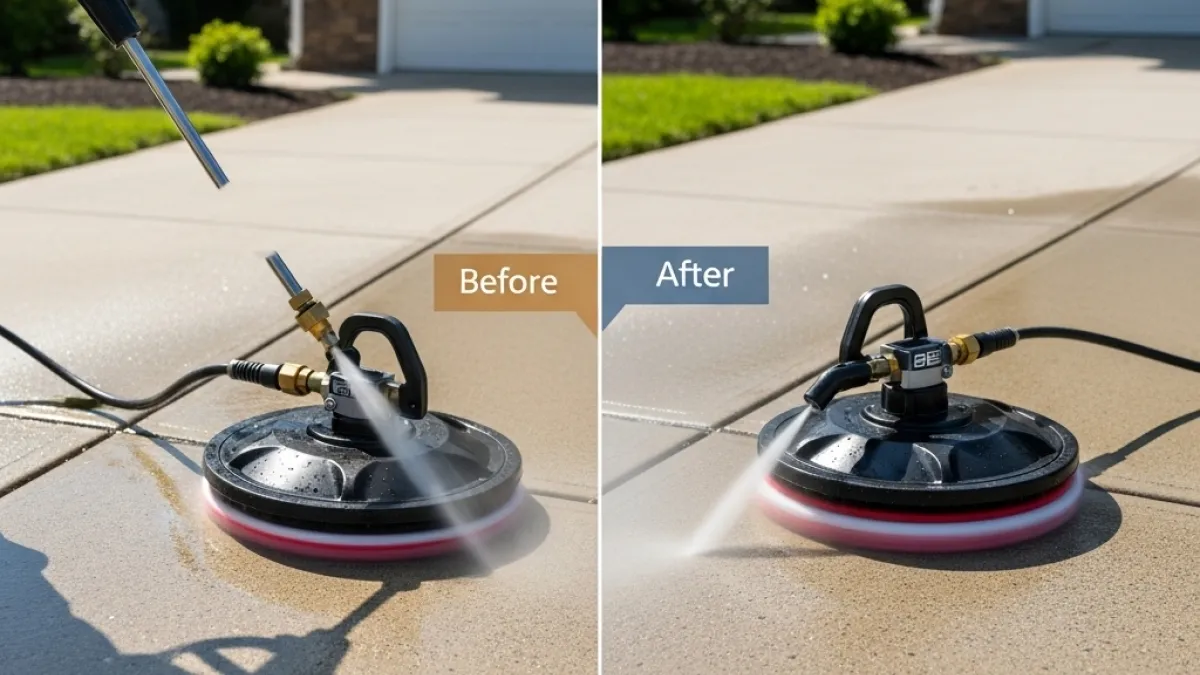
Quick answer: The BE 16-inch surface cleaner runs on a dual-nozzle rotating spray bar rated for up to 4,000 PSI and requires a pressure washer output of 2.5 to 4.0 GPM. It cleans flat concrete up to four times faster than a standard wand while completely eliminating streak marks, making it ideal for residential driveways, patios, and light commercial jobs.
Why the BE Surface Cleaner 16 Is Built for Performance
Understanding how the BE surface cleaner 16 operates starts with its internal rotary mechanism. Inside the rugged outer housing, a heavy-duty brass or stainless steel swivel joint feeds high-pressure water down into a dual-arm spray bar. The spray bar is fitted with two 1/4-inch MEG spray nozzles angled at a precise pitch. When pressurized water blasts out of these nozzles, it creates a centrifugal reaction that spins the bar at over 1,500 RPM, creating a consistent 16-inch washing path with zero manual rotation required on your part.
The primary advantage of this design is continuous nozzle height. When you hold a pressure washer wand by hand, your distance from the surface varies constantly by a few inches, altering the impact force and leaving dark stripes where the spray tip drifted too high. The solid deck of the BE cleaner keeps the spray nozzles fixed exactly one to two inches off the ground throughout your entire pass. This delivers uniform impact force across every square inch of concrete, breaking down embedded oil stains, algae, and grime without digging into the substrate surface.
BE Power Equipment offers this 16-inch platform in two main deck construction styles: high-density polypropylene and solid stainless steel. Polypropylene models are lightweight, highly resistant to chemical corrosion, and easier to lift into the back of a service truck. Stainless steel models add structural rigidity and extra down-force weight, which prevents the unit from lifting or "floating" off the ground when connected to high-volume 4.0 GPM pressure washers. If you are comparing equipment for your setup, check out our comprehensive cleaning equipment guides for deeper breakdowns on machine compatibility.
Standard vs. Castor Wheel Models: Handling and Fatigue
When selecting a 16-inch surface cleaner, one of your biggest functional choices is deciding between a hover-style deck and a caster-wheeled model. Standard hover units rely on the force of escaping water and a dense perimeter skirt to create a light cushion of air, allowing the deck to slide across smooth poured concrete easily. However, on rough exposed aggregate, textured pavers, or pitted surfaces, hover decks can catch on high spots, requiring continuous push-and-pull muscle effort from the operator.
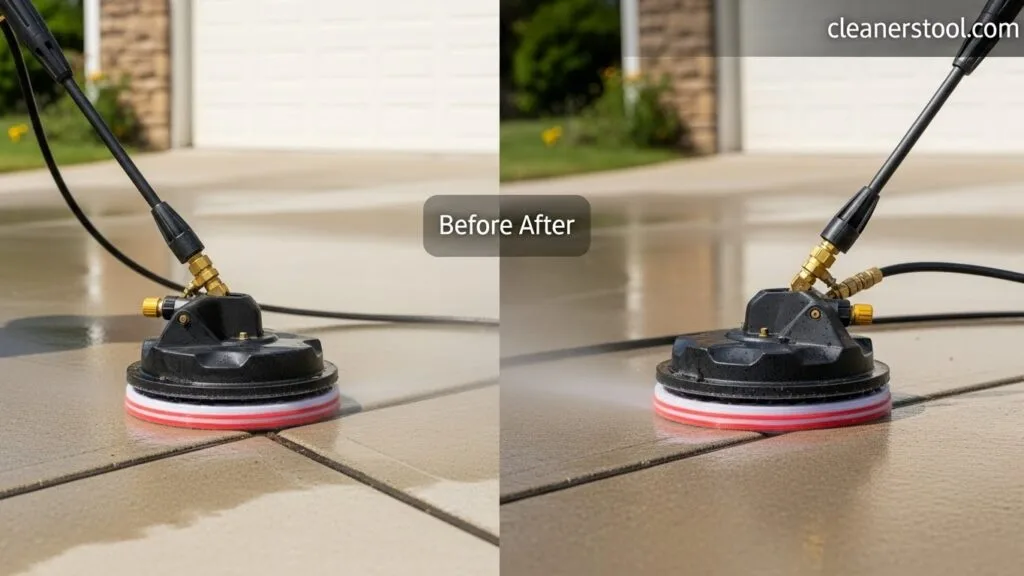
Opting for a BE surface cleaner 16 fitted with heavy-duty caster wheels changes the physical effort entirely. Mounted on three or four non-marking stainless steel swivel casters, a wheeled unit glides effortlessly across bumpy surfaces, uneven expansion joints, and sloped driveways. The casters take 100% of the deck's weight off your arms and lower back, allowing you to walk at a steady, comfortable pace without feeling constant back-pressure force from the spray bar.
Cleaner's tip: Never pull a surface cleaner backward over open expansion joints filled with loose gravel or dirt. The suction and spray bar vortex can draw small pebbles up into the deck, where the spinning bar hits them at 1,500 RPM. This instantly bends your spray bar or chips the spray nozzle orifices. Always push forward, and sweep out deep debris-filled cracks before starting your pressure stroke.
Sizing Your Nozzles and Specifications Comparison
Matching your pressure washer's output to the surface cleaner's spray nozzles is mandatory for optimal performance. If your spray nozzles are too small, your machine's unloader valve will bypass excessive pressure, overheating your pump. If your nozzles are too large, the pressure drops drastically, leaving you without enough cleaning power to break up stubborn organic growth. The BE 16-inch unit comes standard with twin 25020 or 25025 nozzles, designed specifically for pumps putting out 2.5 to 4.0 GPM.
Below is a quick reference guide showing how different machine ratings pair with the BE 16-inch surface cleaner platform and what results you can expect during routine operation:
| Feature / Spec | Entry Poly Series | Commercial Stainless Series |
|---|---|---|
| Deck Diameter | 16 Inches | 16 Inches |
| Max Working Pressure | 3,600 PSI | 4,000 PSI |
| Flow Rate Range | 2.5 GPM – 3.5 GPM | 3.0 GPM – 4.5 GPM |
| Housing Material | Impact-Resistant Polypropylene | 304 Heavy-Duty Stainless Steel |
| Mobility Type | Nylon Brush Skirt / Hover | 4 Stainless Swivel Casters |
| Approximate Weight | 14 lbs | 21 lbs |
| Price Range (2026) | $220 – $340 | $380 – $520 |
If you need to replace your nozzles due to wear or to match a larger GPM pump, make sure to use 1/4-inch NPT male thread spray tips with a 25-degree fan angle. Calculating nozzle size correctly ensures your pump runs at its designated operating pressure while feeding equal volume to both sides of the spray arm.
Step-by-Step Guide to Streak-Free Surface Cleaning
Achieving rapid, professional results on flatwork requires more than just pulling the trigger and pushing the machine. Following a structured surface cleaning routine ensures maximum efficiency and prevents damage to surrounding landscaping or painted surfaces. For more tips on maintaining your outdoor tools, explore our pressure washer maintenance guides.
- Pre-Sweep and Clear Debris: Remove loose gravel, sticks, leaves, and trash from the target area using a stiff-bristled broom or leaf blower. Loose items beneath the deck act as projectiles under high pressure.
- Apply Chemical Pre-Treatment: Spray a mild sodium hypochlorite solution (1.5% to 2.0% SH dilution) or an alkaline outdoor degreaser (pH 11 to 12) across heavily soiled concrete. Allow a dwell time of 5 to 10 minutes to break down organic mold, mildew, and engine oil without letting the solution dry.
- Connect Equipment Correctly: Attach the 16-inch surface cleaner to your high-pressure wand using the standard 1/4-inch quick-connect brass socket. Ensure the connection clicks firmly into place to avoid accidental disconnects under 4,000 PSI pressure.
- Execute Overlapping Passes: Begin cleaning at the highest point of the sloped surface so dirty runoff flows away from your fresh path. Walk in straight, steady lines, overlapping each pass by 2 to 3 inches to guarantee zero missed striping.
- Rinse and Post-Treat: Flush the loosened slurry off the driveway using a low-pressure wide fan nozzle (40-degree tip) or a dedicated rinse ball. Apply a light post-treatment spray of 1% SH to leave concrete bright and clear as it dries.
Always wear safety gear during surface cleaning operation, including wrap-around eye protection, closed-toe waterproof boots, and hearing protection. High-pressure spray can dislodge microscopic sand particles and send them ricocheting outward beneath the nylon skirt.
Maintenance and Caring for Your Surface Cleaner Parts
A surface cleaner is a mechanical investment that requires minor ongoing care to operate smoothly. The single most common cause of failure is a seized swivel head due to water intrusion or lack of lubrication. High-end BE rotary swivels feature a top Zerk grease fitting that should be injected with marine-grade water-resistant grease after every 20 to 30 hours of runtime.
Spray nozzles also demand periodic checks. If dirt or small mineral deposits clog one of the two tips, the spray bar will lose rotational balance. This imbalance causes extreme vibration throughout the handle, reduced cleaning speed, and rapid wear on the swivel bearings. If you notice heavy shaking during operation, stop immediately, unthread the spray tips using an 11/16-inch socket wrench, and clear the nozzle orifices using a fine nozzle cleaning pin or compressed air.
Lastly, inspect the flexible nylon skirt surrounding the perimeter of the deck. This skirt serves two critical functions: keeping high-pressure overspray contained and preventing small stones from flying out toward windows or parked vehicles. If sections of the brush skirt become worn down or torn away from dragging over rough concrete, replacement skirts are readily available as low-cost bolt-on service components.
For residential homeowners looking to clean a standard 2-car driveway two or three times a year, the polypropylene BE 16-inch surface cleaner provides the ideal blend of affordability and speed. Commercial operators or property managers tackling multi-car parking bays and textured aggregate daily should opt for the stainless steel caster-wheeled model, which delivers superior stability, long-term wear resistance, and effortless mobility over harsh terrain.
Frequently Asked Questions
Can I run a BE 16-inch surface cleaner with an electric pressure washer?
Most consumer electric pressure washers deliver between 1.1 and 1.7 GPM, which is insufficient to drive the dual-nozzle spray bar effectively. The BE 16-inch surface cleaner requires a minimum continuous flow rate of 2.5 GPM (typically found on gas-powered units rated at 2,700 PSI or higher) to rotate the spray arm at proper cleaning speeds.
Why is my surface cleaner leaving swirl marks on the concrete?
Swirl marks usually occur when you move the unit too quickly across heavy organic buildup or when your pressure washer pump is not supplying enough GPM for the deck size. Slow your walking speed, ensure your nozzles are free of mineral clogs, and pre-treat dirty surfaces with a suitable chemical cleaner to break up stains prior to pressure washing.
How do I know when to replace the rotary swivel joint?
If water begins leaking heavily out of the top breather hole of the swivel housing, or if the spray arm refuses to spin even after clearing clogged nozzles, the internal mechanical seals or ball bearings inside the swivel joint have failed. Replacement swivels can be unbolted and installed in less than ten minutes.
Can I use hot water with the BE 16-inch surface cleaner?
Standard cold-water BE models are rated for water temperatures up to 140°F. If you operate a hot-water pressure washer rig, make sure you choose a high-temperature commercial version fitted with heat-resistant Viton seals, which can handle inlet temperatures up to 180°F to 200°F.
Sources
- Wikipedia: Pressure Washer Mechanics and Technology
- US Environmental Protection Agency: Outdoor Washing Guidelines
- BE Power Equipment Technical Product Documentation & Specifications Manuals